- Python 71.5%
- TypeScript 22.7%
- Shell 1.9%
- PowerShell 1.6%
- Rust 1.5%
- Other 0.7%
 e159b93b97
* studio: improve GGUF tool calling accuracy and reliability - Add URL fetching to web_search tool so models can read full page content instead of only getting search snippets. Uses html2text for clean markdown conversion with regex fallback. - Inject current date and behavioral guidance (URL fetch workflow, no repeated queries, use code for data processing) into the tool-use system prompt. - Append error recovery nudge to tool results that indicate failure, helping small models avoid looping on the same broken call. - Strip leaked <tool_call> XML from assistant messages in conversation history and from the outgoing SSE stream. - Raise default max tool iterations from 10 to 25 across backend, model schema, and frontend defaults. - Increase _MAX_PAGE_CHARS from 4k to 16k so fetched pages contain enough content for the model to extract useful information. - Add "IMPORTANT: These are only short snippets" hint to search results so models know to fetch full pages when needed. Tested with Qwen3.5-4B-GGUF (UD-Q4_K_XL), 10 runs before/after: - XML leaks in responses: 10/10 -> 0/10 - URL fetch usage: 0 -> 4/10 runs - Runs producing actual correct answers: 0/10 -> 2/10 - Average tool calls per query: 5.5 -> 3.8 (more efficient) - Average response time: 12.3s -> 9.8s * [pre-commit.ci] auto fixes from pre-commit.com hooks for more information, see https://pre-commit.ci * Add tool calling benchmark results across model sizes and quants Tested 16 configurations (4 models x 2 quants x 2 KV cache types) with 10 runs each on NVIDIA B200. Best config: 27B UD-Q4_K_XL + bf16 KV -- 6/10 runs found all 4 correct songs, 0 XML leaks, 131s average response time. * Add duplicate tool-call detection and final-answer synthesis When the model repeats the exact same tool call (same name + arguments) twice in a row, skip execution and return a redirect message telling it to try a different approach. This prevents the 8x-repeated-query loops observed on 27B and 35B models. When the tool iteration cap (25) is reached, inject a "provide your final answer now" message before the final streaming pass. This lets the model synthesize a useful answer from everything it gathered instead of being silently cut off. Tested on Qwen3.5-27B UD-Q4_K_XL (10 runs): - Repeated query runs: 4/10 -> 2/10 - Cap hits: 1/10 -> 0/10 - All 4/4 accuracy: 5/10 -> 7/10 * [pre-commit.ci] auto fixes from pre-commit.com hooks for more information, see https://pre-commit.ci * Fix CodeQL alert: handle whitespace in script/style closing tags The regex fallback for HTML stripping did not match closing tags with whitespace before the angle bracket (e.g. </script >). Use \s* before > in both script and style patterns. * Address reviewer findings: SSRF, timeout crash, XML regex, dedup - SSRF: resolve hostname via getaddrinfo and reject private, loopback, link-local, multicast, and reserved addresses before fetching - Timeout: handle timeout=None (unlimited mode) in URL fetch path by defaulting to 60s instead of crashing on min(None, 60) - Download cap: read at most max_chars*4+1 bytes instead of the full response body before truncating - XML regex: match both <tool_call> and <function=...> markup in the history/stream cleanup (inference.py) - CodeQL: use [^>]* in closing script/style tags to handle any whitespace or attributes before > - Dedup: track whether each tool call failed so retries after transient errors are allowed; only block consecutive identical calls that both succeeded - Final-answer synthesis: guard on max_tool_iterations > 0 so callers who disable tools do not get a false "used all calls" turn * [pre-commit.ci] auto fixes from pre-commit.com hooks for more information, see https://pre-commit.ci * Fix redirect SSRF, SSE streaming regression, dedup off-by-one - SSRF redirect bypass: disable auto-redirect in urllib, manually follow up to 5 hops with host validation at each step. Prevents public URLs from redirecting to loopback/private targets. - SSE streaming: track prev_text on the raw cumulative and strip XML from the delta only, so completed tool_call tags do not cause the cumulative to shrink and drop trailing real text. - Dedup off-by-one: check the immediately previous call (window=1) instead of requiring 2 matching history entries, so the second identical successful call is blocked rather than the third. * [pre-commit.ci] auto fixes from pre-commit.com hooks for more information, see https://pre-commit.ci * Fix redirect HTTPError handling and tighten error prefixes - Redirect fix: urllib raises HTTPError (not a normal response) when the redirect handler returns None. Catch HTTPError for 3xx codes and extract the Location header from the exception object. - Error prefixes: remove overly broad "No " prefix that matched "No results found." (a valid empty-search outcome, not an error). Replace with specific prefixes like "Blocked:", "No query provided", "Failed to resolve". This ensures empty search results are correctly classified as non-errors for duplicate-call tracking. * Fix SSE cross-chunk XML leaks, cleanup review findings - SSE streaming: sanitize the full cumulative text before diffing against the previous sanitized snapshot, so XML tags that span chunk boundaries are stripped correctly. The previous delta-based approach leaked split tags. - DRAINING fallback: use _strip_tool_markup() helper instead of a manual regex that only handled <tool_call> but not <function=...>. - Move hashlib import, _TOOL_XML_RE compile, and datetime import to module level per style guide. - Remove unused _hit_tool_cap variable. * Fix DNS rebinding, charset detection, HTTPError handling, dedup double-record - DNS rebinding: resolve hostname once via getaddrinfo, pin the returned IP, rewrite the URL to connect to the pinned IP with a Host header. Each redirect hop re-resolves and re-validates. Closes the TOCTOU window between validation and connection. - Charset: use resp.headers.get_content_charset() instead of hardcoding utf-8, so pages with other encodings decode correctly. - HTTPError: return descriptive "HTTP {code} {reason}" instead of re-raising into a generic "Search failed" message. - Dedup: remove redundant _record_tool_call in the duplicate branch; the single call at the end of the loop handles all cases. * [pre-commit.ci] auto fixes from pre-commit.com hooks for more information, see https://pre-commit.ci --------- Co-authored-by: pre-commit-ci[bot] <66853113+pre-commit-ci[bot]@users.noreply.github.com> |
||
|---|---|---|
| .github | ||
| images | ||
| scripts | ||
| studio | ||
| tests | ||
| unsloth | ||
| unsloth_cli | ||
| .gitattributes | ||
| .gitignore | ||
| .pre-commit-ci.yaml | ||
| .pre-commit-config.yaml | ||
| build.sh | ||
| cli.py | ||
| CODE_OF_CONDUCT.md | ||
| CONTRIBUTING.md | ||
| COPYING | ||
| install.ps1 | ||
| install.sh | ||
| LICENSE | ||
| pyproject.toml | ||
| README.md | ||
| unsloth-cli.py | ||

Run and train AI models with a unified local interface.
Features • Quickstart • Notebooks • Documentation • Reddit
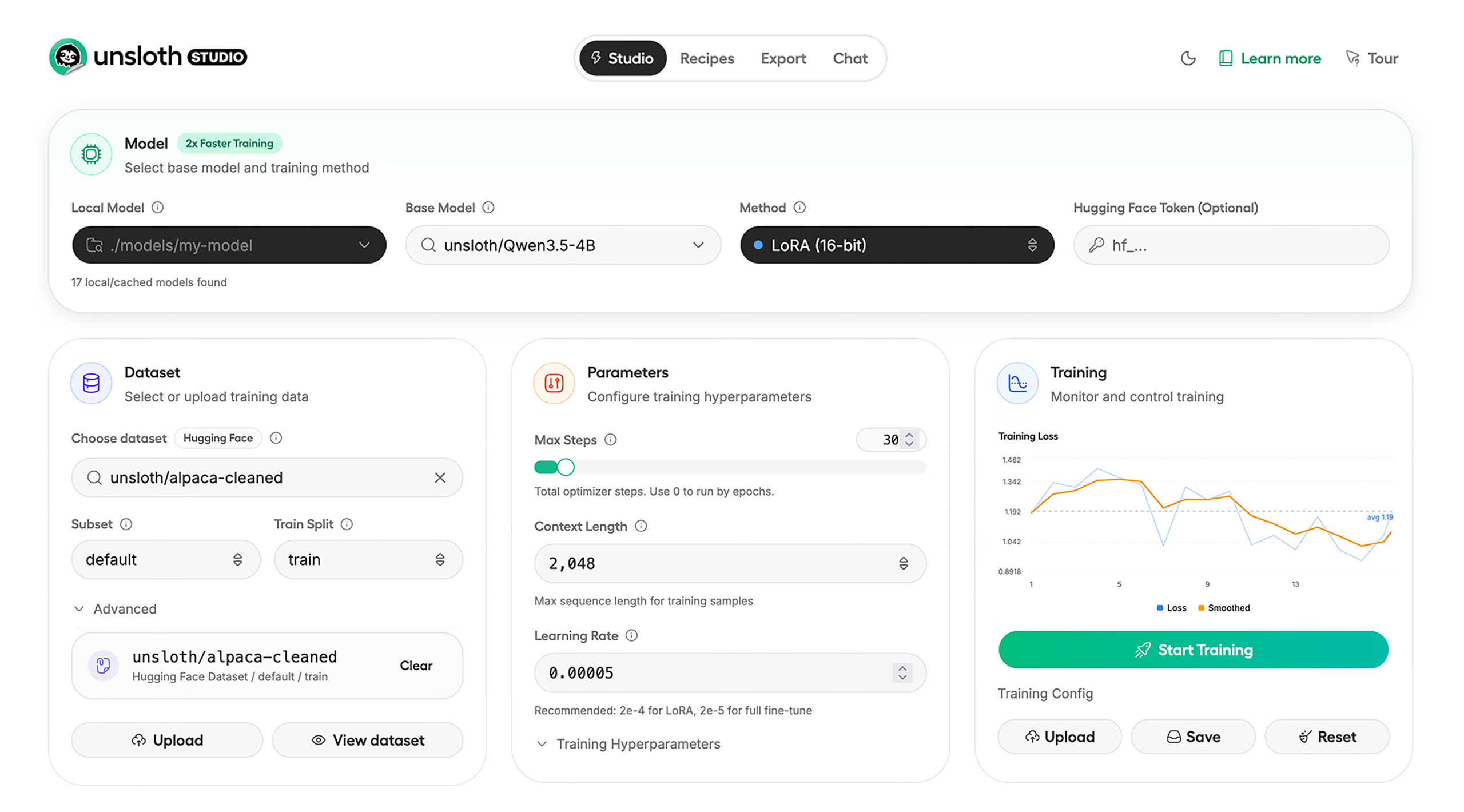
Unsloth Studio (Beta) lets you run and train text, audio, embedding, vision models on Windows, Linux and macOS.
⭐ Features
Unsloth provides several key features for both inference and training:
Inference
- Search + download + run models including GGUF, LoRA adapters, safetensors
- Export models: Save or export models to GGUF, 16-bit safetensors and other formats.
- Tool calling: Support for self-healing tool calling and web search
- Code execution: lets LLMs test code in Claude artifacts and sandbox environments
- Auto-tune inference parameters and customize chat templates.
- We work directly with teams behind gpt-oss, Qwen3, Llama 4, Mistral, Gemma 1-3, and Phi-4, where we’ve fixed bugs that improve model accuracy.
- Upload images, audio, PDFs, code, DOCX and more file types to chat with.
Training
- Train and RL 500+ models up to 2x faster with up to 70% less VRAM, with no accuracy loss.
- Custom Triton and mathematical kernels. See some collabs we did with PyTorch and Hugging Face.
- Data Recipes: Auto-create datasets from PDF, CSV, DOCX etc. Edit data in a visual-node workflow.
- Reinforcement Learning (RL): The most efficient RL library, using 80% less VRAM for GRPO, FP8 etc.
- Supports full fine-tuning, RL, pretraining, 4-bit, 16-bit and, FP8 training.
- Observability: Monitor training live, track loss and GPU usage and customize graphs.
- Multi-GPU training is supported, with major improvements coming soon.
⚡ Quickstart
Unsloth can be used in two ways: through Unsloth Studio, the web UI, or through Unsloth Core, the code-based version. Each has different requirements.
Unsloth Studio (web UI)
Unsloth Studio (Beta) works on Windows, Linux, WSL and macOS.
- CPU: Supported for Chat and Data Recipes currently
- NVIDIA: Training works on RTX 30/40/50, Blackwell, DGX Spark, Station and more
- macOS: Currently supports chat and Data Recipes. MLX training is coming very soon
- AMD: Chat + Data works. Train with Unsloth Core. Studio support is out soon.
- Coming soon: Training support for Apple MLX, AMD, and Intel.
- Multi-GPU: Available now, with a major upgrade on the way
macOS, Linux, WSL:
curl -fsSL https://unsloth.ai/install.sh | sh
Windows:
irm https://unsloth.ai/install.ps1 | iex
Launch
unsloth studio -H 0.0.0.0 -p 8888
Update
To update, use the same install commands as above. Or run (does not work on Windows):
unsloth studio update
Docker
Use our Docker image unsloth/unsloth container. Run:
docker run -d -e JUPYTER_PASSWORD="mypassword" \
  -p 8888:8888 -p 8000:8000 -p 2222:22 \
  -v $(pwd)/work:/workspace/work \
  --gpus all \
  unsloth/unsloth
Developer, Nightly, Uninstall
To see developer, nightly and uninstallation etc. instructions, see advanced installation.
Unsloth Core (code-based)
Linux, WSL:
curl -LsSf https://astral.sh/uv/install.sh | sh
uv venv unsloth_env --python 3.13
source unsloth_env/bin/activate
uv pip install unsloth --torch-backend=auto
Windows:
winget install -e --id Python.Python.3.13
winget install --id=astral-sh.uv  -e
uv venv unsloth_env --python 3.13
.\unsloth_env\Scripts\activate
uv pip install unsloth --torch-backend=auto
For Windows, pip install unsloth works only if you have PyTorch installed. Read our Windows Guide.
You can use the same Docker image as Unsloth Studio.
AMD, Intel:
For RTX 50x, B200, 6000 GPUs: uv pip install unsloth --torch-backend=auto. Read our guides for: Blackwell and DGX Spark.
To install Unsloth on AMD and Intel GPUs, follow our AMD Guide and Intel Guide.
✨ Free Notebooks
Train for free with our notebooks. Read our guide. Add dataset, run, then deploy your trained model.
| Model | Free Notebooks | Performance | Memory use |
|---|---|---|---|
| Qwen3.5 (4B) | ▶️ Start for free | 1.5x faster | 60% less |
| gpt-oss (20B) | ▶️ Start for free | 2x faster | 70% less |
| Qwen3.5 GSPO | ▶️ Start for free | 2x faster | 70% less |
| gpt-oss (20B): GRPO | ▶️ Start for free | 2x faster | 80% less |
| Qwen3: Advanced GRPO | ▶️ Start for free | 2x faster | 70% less |
| Gemma 3 (4B) Vision | ▶️ Start for free | 1.7x faster | 60% less |
| embeddinggemma (300M) | ▶️ Start for free | 2x faster | 20% less |
| Mistral Ministral 3 (3B) | ▶️ Start for free | 1.5x faster | 60% less |
| Llama 3.1 (8B) Alpaca | ▶️ Start for free | 2x faster | 70% less |
| Llama 3.2 Conversational | ▶️ Start for free | 2x faster | 70% less |
| Orpheus-TTS (3B) | ▶️ Start for free | 1.5x faster | 50% less |
- See all our notebooks for: Kaggle, GRPO, TTS, embedding & Vision
- See all our models and all our notebooks
- See detailed documentation for Unsloth here
🦥 Unsloth News
- Introducing Unsloth Studio: our new web UI for running and training LLMs. Blog
- Qwen3.5 - 0.8B, 2B, 4B, 9B, 27B, 35-A3B, 112B-A10B are now supported. Guide + notebooks
- Train MoE LLMs 12x faster with 35% less VRAM - DeepSeek, GLM, Qwen and gpt-oss. Blog
- Embedding models: Unsloth now supports ~1.8-3.3x faster embedding fine-tuning. Blog • Notebooks
- New 7x longer context RL vs. all other setups, via our new batching algorithms. Blog
- New RoPE & MLP Triton Kernels & Padding Free + Packing: 3x faster training & 30% less VRAM. Blog
- 500K Context: Training a 20B model with >500K context is now possible on an 80GB GPU. Blog
- FP8 & Vision RL: You can now do FP8 & VLM GRPO on consumer GPUs. FP8 Blog • Vision RL
- gpt-oss by OpenAI: Read our RL blog, Flex Attention blog and Guide.
📥 Advanced Installation
The below advanced instructions are for Unsloth Studio. For Unsloth Core advanced installation, view our docs.
Developer installs: macOS, Linux, WSL:
git clone https://github.com/unslothai/unsloth
cd unsloth
./install.sh --local
unsloth studio -H 0.0.0.0 -p 8888
Then to update :
unsloth studio update
Developer installs: Windows PowerShell:
git clone https://github.com/unslothai/unsloth.git
cd unsloth
Set-ExecutionPolicy -Scope Process -ExecutionPolicy Bypass
.\install.ps1 --local
unsloth studio -H 0.0.0.0 -p 8888
Then to update :
unsloth studio update
Nightly: MacOS, Linux, WSL:
git clone https://github.com/unslothai/unsloth
cd unsloth
git checkout nightly
./install.sh --local
unsloth studio -H 0.0.0.0 -p 8888
Then to launch every time:
unsloth studio -H 0.0.0.0 -p 8888
Nightly: Windows:
Run in Windows Powershell:
git clone https://github.com/unslothai/unsloth.git
cd unsloth
git checkout nightly
Set-ExecutionPolicy -Scope Process -ExecutionPolicy Bypass
.\install.ps1 --local
unsloth studio -H 0.0.0.0 -p 8888
Then to launch every time:
unsloth studio -H 0.0.0.0 -p 8888
Uninstall
You can uninstall Unsloth Studio by deleting its install folder usually located under $HOME/.unsloth/studio on Mac/Linux/WSL and %USERPROFILE%\.unsloth\studio on Windows. Using the rm -rf commands will delete everything, including your history, cache:
- MacOS, WSL, Linux:
rm -rf ~/.unsloth/studio - Windows (PowerShell):
Remove-Item -Recurse -Force "$HOME\.unsloth\studio"
For more info, see our docs.
Deleting model files
You can delete old model files either from the bin icon in model search or by removing the relevant cached model folder from the default Hugging Face cache directory. By default, HF uses:
- MacOS, Linux, WSL:
~/.cache/huggingface/hub/ - Windows:
%USERPROFILE%\.cache\huggingface\hub\
💚 Community and Links
| Type | Links |
|---|---|
 Discord Discord |
Join Discord server |
 r/unsloth Reddit r/unsloth Reddit |
Join Reddit community |
| 📚 Documentation & Wiki | Read Our Docs |
_logo_late_2025.svg) Twitter (aka X) Twitter (aka X) |
Follow us on X |
| 🔮 Our Models | Unsloth Catalog |
| ✍️ Blog | Read our Blogs |
Citation
You can cite the Unsloth repo as follows:
@software{unsloth,
  author = {Daniel Han, Michael Han and Unsloth team},
  title = {Unsloth},
  url = {https://github.com/unslothai/unsloth},
  year = {2023}
}
If you trained a model with 🦥Unsloth, you can use this cool sticker!
License
Unsloth uses a dual-licensing model of Apache 2.0 and AGPL-3.0. The core Unsloth package remains licensed under Apache 2.0, while certain optional components, such as the Unsloth Studio UI are licensed under the open-source license AGPL-3.0.
This structure helps support ongoing Unsloth development while keeping the project open source and enabling the broader ecosystem to continue growing.
Thank You to
- The llama.cpp library that lets users run and save models with Unsloth
- The Hugging Face team and their libraries: transformers and TRL
- The Pytorch and Torch AO team for their contributions
- NVIDIA for their NeMo DataDesigner library and their contributions
- And of course for every single person who has contributed or has used Unsloth!