- Python 71.5%
- TypeScript 22.7%
- Shell 1.9%
- PowerShell 1.6%
- Rust 1.5%
- Other 0.7%
 9311df2b29
* [WIP] balanced device map for studio * gpus as a request parameter * API for multi GPU stuff * return multi gpu util in new API * [pre-commit.ci] auto fixes from pre-commit.com hooks for more information, see https://pre-commit.ci * Use balanced_low0 instead of balanced * Use balanced_low0 instead of balanced * Fix device_map typo, UUID parsing crash, set() filter bug, and broken tests - balanced_low0 -> balanced_low_0 (transformers/accelerate rejects the old string) - get_parent_visible_gpu_ids() now handles UUID/MIG CUDA_VISIBLE_DEVICES gracefully instead of crashing on int() parse - _get_backend_visible_gpu_info() set() or None bug: empty set is falsy so CUDA_VISIBLE_DEVICES=-1 would disable filtering and report all GPUs - test_gpu_selection.py: add missing get_visible_gpu_utilization import and add required job_id arg to start_training() calls * Smart GPU determinism using estimates * [pre-commit.ci] auto fixes from pre-commit.com hooks for more information, see https://pre-commit.ci * disallow gpu selection for gguf for now * cleanup * Slightly larger baseline * [pre-commit.ci] auto fixes from pre-commit.com hooks for more information, see https://pre-commit.ci * Treat empty list as auto * Verbose logging/debug * [pre-commit.ci] auto fixes from pre-commit.com hooks for more information, see https://pre-commit.ci * Cleanup and revert unnecessary deletions * Cleanup excessive logs and guard against disk/cpu offload * auth for visibility API. cleanup redundant imports. Adjust QLoRA estimate * [pre-commit.ci] auto fixes from pre-commit.com hooks for more information, see https://pre-commit.ci * support for non cuda gpus * Fix multi-GPU auto-selection memory accounting The multi_gpu_factor was applied uniformly to all GPUs including the first one, which unfairly penalizes single-GPU capacity when transitioning to multi-GPU. This created a discontinuity where a model that barely fits 1 GPU would suddenly require 2 GPUs because the first GPU's free memory was discounted by 20%. Now the first GPU keeps its full free memory, and only additional GPUs have an overhead factor (0.85) applied to account for inter-GPU communication and sharding overhead. This gives more accurate auto-selection and avoids unnecessary multi-GPU for models that comfortably fit on one device. * [pre-commit.ci] auto fixes from pre-commit.com hooks for more information, see https://pre-commit.ci * Add sandbox tests for multi-GPU selection logic 24 tests covering model size estimation, memory requirements, automatic GPU selection, device map generation, GPU ID validation, and multi-GPU overhead accounting. All tests use mocks so they run without GPUs on Linux, macOS, and Windows. * [pre-commit.ci] auto fixes from pre-commit.com hooks for more information, see https://pre-commit.ci * Fix reviewer findings: 4bit inference estimate, fallback, GGUF gpu_ids, retry 1. 4-bit inference now uses reduced memory estimate (model_size/3 + buffer) instead of the FP16 1.3x multiplier. This prevents over-sharding quantized models across unnecessary GPUs. 2. When model size estimation fails, auto_select_gpu_ids now falls back to all visible GPUs instead of returning None (which could default to single-GPU loading for an unknown-size model). 3. GGUF inference route now treats gpu_ids=[] as auto-selection (same as None) instead of rejecting it as an unsupported explicit request. 4. Training retry path for "could not get source code" now preserves the gpu_ids parameter so the retry lands on the same GPUs. 5. Updated sandbox tests to cover the new 4-bit inference estimate branch. * Remove accidentally added unsloth-zoo submodule * [pre-commit.ci] auto fixes from pre-commit.com hooks for more information, see https://pre-commit.ci * Fix UUID/MIG visibility and update test expectations 1. nvidia.py: When CUDA_VISIBLE_DEVICES uses UUID/MIG tokens, the visibility APIs now return "unresolved" with empty device lists instead of exposing all physical GPUs. This prevents the UI from showing GPUs that the backend process cannot actually use. 2. test_gpu_selection.py: Updated test expectations to match the new multi-GPU overhead accounting (first GPU at full capacity, 0.85x for additional GPUs) and 4-bit inference memory estimation formula. All 60 tests now pass. * Add CPU/disk offload guard to audio inference path The audio model loading branch returned before the common get_offloaded_device_map_entries() check, so audio models loaded with a multi-GPU device_map that spilled layers to CPU/disk would be accepted instead of rejected. Now audio loads also verify no modules are offloaded. * Improve VRAM requirement estimates * Replace balanced_low_0 with balanced * [pre-commit.ci] auto fixes from pre-commit.com hooks for more information, see https://pre-commit.ci * refine calculations for slightly easier nums * [pre-commit.ci] auto fixes from pre-commit.com hooks for more information, see https://pre-commit.ci * adjust estimates * [pre-commit.ci] auto fixes from pre-commit.com hooks for more information, see https://pre-commit.ci * Use nums instead of obj to avoid seralisation error * [pre-commit.ci] auto fixes from pre-commit.com hooks for more information, see https://pre-commit.ci * Harden nvidia-smi parsing and fix fallback GPU list 1. nvidia.py: Wrap int() casts for GPU index and memory in try/except so MIG slices, N/A values, or unexpected nvidia-smi output skip the unparseable row instead of aborting the entire GPU list. 2. nvidia.py: Handle GPU names containing commas by using the last field as memory instead of a fixed positional index. 3. hardware.py: fallback_all now uses gpu_candidates (GPUs with verified VRAM data) instead of raw devices list, which could include GPUs with null VRAM that were excluded from the ranking. * [pre-commit.ci] auto fixes from pre-commit.com hooks for more information, see https://pre-commit.ci * cleanup * [pre-commit.ci] auto fixes from pre-commit.com hooks for more information, see https://pre-commit.ci * consolidate raise_if_offload * Improve MoE support. Guard against nvidia-smi failures * Improve MoE support. Guard against nvidia-smi failures * [pre-commit.ci] auto fixes from pre-commit.com hooks for more information, see https://pre-commit.ci * Fix shared-expert LoRA undercount, torch VRAM fallback, and apply_gpu_ids edge case 1. vram_estimation.py: compute_lora_params now includes shared experts (n_shared_experts) alongside routed experts when computing MoE LoRA adapter parameters. Previously only n_experts were counted, causing the estimator to undercount adapter, optimizer, and gradient memory for DeepSeek/GLM-style models with shared experts. 2. hardware.py: _torch_get_per_device_info now uses mem_get_info (which reports system-wide VRAM usage) instead of memory_allocated (which only reports this process's PyTorch allocations). This prevents auto-selection from treating a GPU as mostly free when another process is consuming VRAM. Falls back to memory_allocated when mem_get_info is unavailable. 3. hardware.py: apply_gpu_ids([]) now returns early instead of setting CUDA_VISIBLE_DEVICES="" which would disable CUDA entirely. Empty list inherits the parent visibility, same as None. 4. hardware.py: Upgraded fallback_all GPU selection log from debug to warning so operators are notified when the model likely will not fit in available VRAM. * Guard nvidia-smi subprocess calls against OSError and TimeoutExpired get_visible_gpu_utilization and get_backend_visible_gpu_info now catch OSError (nvidia-smi not found) and TimeoutExpired internally instead of relying on callers to wrap every invocation. Returns the standard available=False sentinel on failure so the torch-based fallback in hardware.py can take over. * Guard get_primary_gpu_utilization and reset GPU caches between tests 1. nvidia.py: get_primary_gpu_utilization now catches OSError and TimeoutExpired internally, matching the pattern already used in get_visible_gpu_utilization and get_backend_visible_gpu_info. All three nvidia-smi callers are now self-contained. 2. test_gpu_selection.py: Added _GpuCacheResetMixin that resets the module-level _physical_gpu_count and _visible_gpu_count caches in tearDown. Applied to all test classes that exercise GPU selection, device map, or visibility functions. This prevents stale cache values from leaking between tests and causing flaky results on machines with real GPUs. * Fix nvidia-smi fallback regression and physical GPU count validation 1. hardware.py: get_gpu_utilization, get_visible_gpu_utilization, and get_backend_visible_gpu_info now check result.get("available") before returning the nvidia-smi result. When nvidia-smi is unavailable or returns no data (e.g., containers without nvidia-smi, UUID/MIG masks), the functions fall through to the torch-based fallback instead of returning an empty result. This fixes a regression where the internal exception handling in nvidia.py prevented the caller's except block from triggering the fallback. 2. hardware.py: resolve_requested_gpu_ids now separates negative-ID validation from physical upper-bound validation. The physical count check is only enforced when it is plausibly a true physical count (i.e., higher than the largest parent-visible ID), since torch.cuda.device_count() under CUDA_VISIBLE_DEVICES returns the visible count, not the physical total. The parent-visible-set check remains authoritative in all cases. This prevents valid physical IDs like [2, 3] from being rejected as "out of range" when nvidia-smi is unavailable and CUDA_VISIBLE_DEVICES="2,3" makes torch report only 2 devices. * Fix UUID/MIG torch fallback to enumerate devices by ordinal When CUDA_VISIBLE_DEVICES uses UUID or MIG identifiers, get_parent_visible_gpu_ids() returns [] because the tokens are non-numeric. The torch fallback in get_visible_gpu_utilization() and get_backend_visible_gpu_info() previously passed that empty list to _torch_get_per_device_info(), getting nothing back. Now both functions detect the empty-list case and fall back to enumerating torch-visible ordinals (0..device_count-1) with index_kind="relative". This means the UI and auto-selection still see real device data in Kubernetes, MIG, and Slurm-style UUID environments where nvidia-smi output cannot be mapped to physical indices. Updated test_uuid_parent_visibility to verify the new torch fallback path returns available=True with relative ordinals. * [pre-commit.ci] auto fixes from pre-commit.com hooks for more information, see https://pre-commit.ci * Add type hint for gpu_ids parameter in InferenceOrchestrator.load_model --------- Co-authored-by: pre-commit-ci[bot] <66853113+pre-commit-ci[bot]@users.noreply.github.com> Co-authored-by: Daniel Han <danielhanchen@gmail.com> |
||
|---|---|---|
| .github | ||
| images | ||
| scripts | ||
| studio | ||
| tests | ||
| unsloth | ||
| unsloth_cli | ||
| .gitattributes | ||
| .gitignore | ||
| .pre-commit-ci.yaml | ||
| .pre-commit-config.yaml | ||
| build.sh | ||
| cli.py | ||
| CODE_OF_CONDUCT.md | ||
| CONTRIBUTING.md | ||
| COPYING | ||
| install.ps1 | ||
| install.sh | ||
| LICENSE | ||
| pyproject.toml | ||
| README.md | ||
| unsloth-cli.py | ||

Run and train AI models with a unified local interface.
Features • Quickstart • Notebooks • Documentation • Reddit
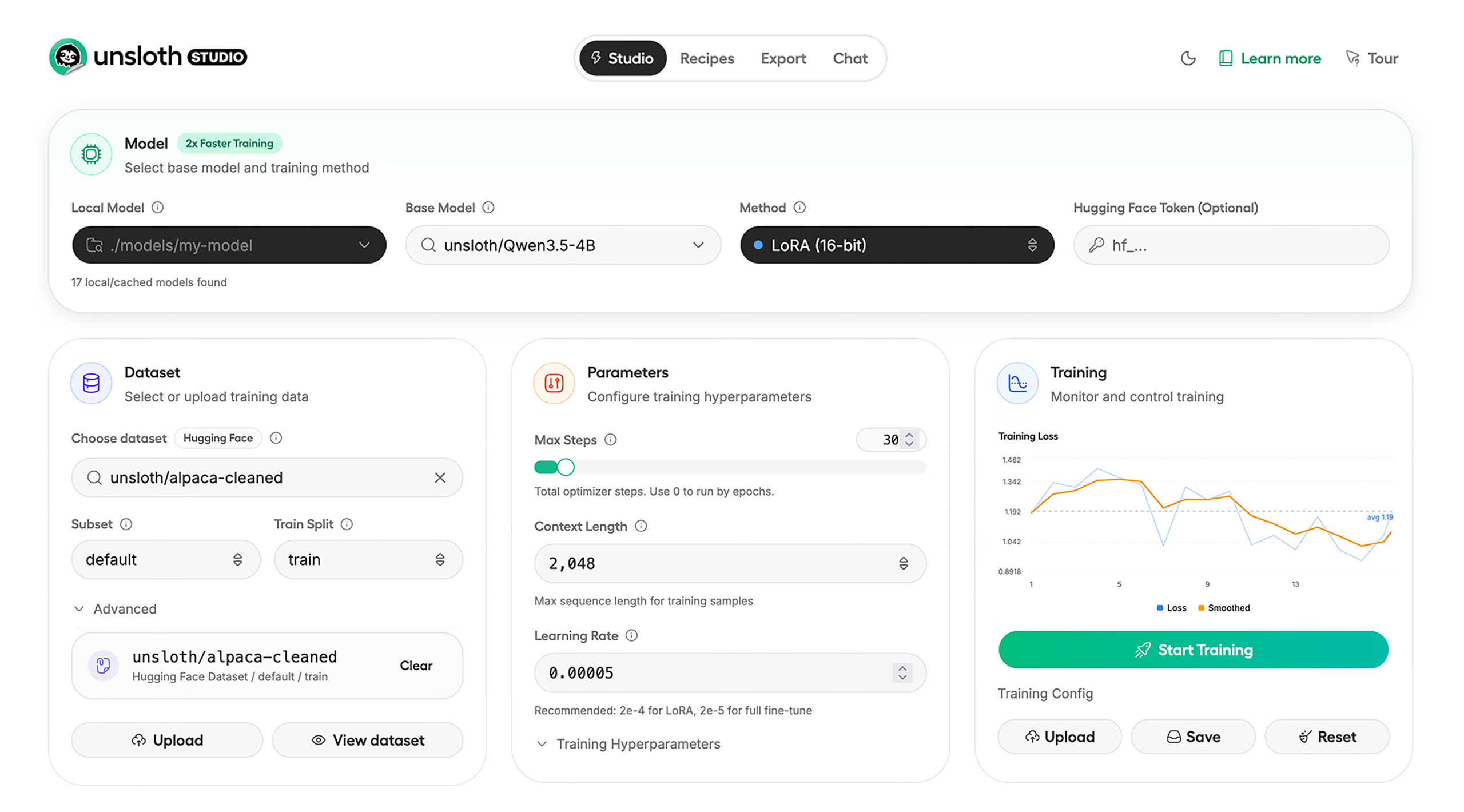
Unsloth Studio (Beta) lets you run and train text, audio, embedding, vision models on Windows, Linux and macOS.
⭐ Features
Unsloth provides several key features for both inference and training:
Inference
- Search + download + run models including GGUF, LoRA adapters, safetensors
- Export models: Save or export models to GGUF, 16-bit safetensors and other formats.
- Tool calling: Support for self-healing tool calling and web search
- Code execution: lets LLMs test code in Claude artifacts and sandbox environments
- Auto-tune inference parameters and customize chat templates.
- We work directly with teams behind gpt-oss, Qwen3, Llama 4, Mistral, Gemma 1-3, and Phi-4, where we’ve fixed bugs that improve model accuracy.
- Upload images, audio, PDFs, code, DOCX and more file types to chat with.
Training
- Train and RL 500+ models up to 2x faster with up to 70% less VRAM, with no accuracy loss.
- Custom Triton and mathematical kernels. See some collabs we did with PyTorch and Hugging Face.
- Data Recipes: Auto-create datasets from PDF, CSV, DOCX etc. Edit data in a visual-node workflow.
- Reinforcement Learning (RL): The most efficient RL library, using 80% less VRAM for GRPO, FP8 etc.
- Supports full fine-tuning, RL, pretraining, 4-bit, 16-bit and, FP8 training.
- Observability: Monitor training live, track loss and GPU usage and customize graphs.
- Multi-GPU training is supported, with major improvements coming soon.
⚡ Quickstart
Unsloth can be used in two ways: through Unsloth Studio, the web UI, or through Unsloth Core, the code-based version. Each has different requirements.
Unsloth Studio (web UI)
Unsloth Studio (Beta) works on Windows, Linux, WSL and macOS.
- CPU: Supported for Chat and Data Recipes currently
- NVIDIA: Training works on RTX 30/40/50, Blackwell, DGX Spark, Station and more
- macOS: Currently supports chat and Data Recipes. MLX training is coming very soon
- AMD: Chat + Data works. Train with Unsloth Core. Studio support is out soon.
- Coming soon: Training support for Apple MLX, AMD, and Intel.
- Multi-GPU: Available now, with a major upgrade on the way
macOS, Linux, WSL:
curl -fsSL https://unsloth.ai/install.sh | sh
Windows:
irm https://unsloth.ai/install.ps1 | iex
Launch
unsloth studio -H 0.0.0.0 -p 8888
Update
To update, use the same install commands as above. Or run (does not work on Windows):
unsloth studio update
Docker
Use our Docker image unsloth/unsloth container. Run:
docker run -d -e JUPYTER_PASSWORD="mypassword" \
  -p 8888:8888 -p 8000:8000 -p 2222:22 \
  -v $(pwd)/work:/workspace/work \
  --gpus all \
  unsloth/unsloth
Developer, Nightly, Uninstall
To see developer, nightly and uninstallation etc. instructions, see advanced installation.
Unsloth Core (code-based)
Linux, WSL:
curl -LsSf https://astral.sh/uv/install.sh | sh
uv venv unsloth_env --python 3.13
source unsloth_env/bin/activate
uv pip install unsloth --torch-backend=auto
Windows:
winget install -e --id Python.Python.3.13
winget install --id=astral-sh.uv  -e
uv venv unsloth_env --python 3.13
.\unsloth_env\Scripts\activate
uv pip install unsloth --torch-backend=auto
For Windows, pip install unsloth works only if you have PyTorch installed. Read our Windows Guide.
You can use the same Docker image as Unsloth Studio.
AMD, Intel:
For RTX 50x, B200, 6000 GPUs: uv pip install unsloth --torch-backend=auto. Read our guides for: Blackwell and DGX Spark.
To install Unsloth on AMD and Intel GPUs, follow our AMD Guide and Intel Guide.
✨ Free Notebooks
Train for free with our notebooks. Read our guide. Add dataset, run, then deploy your trained model.
| Model | Free Notebooks | Performance | Memory use |
|---|---|---|---|
| Qwen3.5 (4B) | ▶️ Start for free | 1.5x faster | 60% less |
| gpt-oss (20B) | ▶️ Start for free | 2x faster | 70% less |
| Qwen3.5 GSPO | ▶️ Start for free | 2x faster | 70% less |
| gpt-oss (20B): GRPO | ▶️ Start for free | 2x faster | 80% less |
| Qwen3: Advanced GRPO | ▶️ Start for free | 2x faster | 70% less |
| Gemma 3 (4B) Vision | ▶️ Start for free | 1.7x faster | 60% less |
| embeddinggemma (300M) | ▶️ Start for free | 2x faster | 20% less |
| Mistral Ministral 3 (3B) | ▶️ Start for free | 1.5x faster | 60% less |
| Llama 3.1 (8B) Alpaca | ▶️ Start for free | 2x faster | 70% less |
| Llama 3.2 Conversational | ▶️ Start for free | 2x faster | 70% less |
| Orpheus-TTS (3B) | ▶️ Start for free | 1.5x faster | 50% less |
- See all our notebooks for: Kaggle, GRPO, TTS, embedding & Vision
- See all our models and all our notebooks
- See detailed documentation for Unsloth here
🦥 Unsloth News
- Introducing Unsloth Studio: our new web UI for running and training LLMs. Blog
- Qwen3.5 - 0.8B, 2B, 4B, 9B, 27B, 35-A3B, 112B-A10B are now supported. Guide + notebooks
- Train MoE LLMs 12x faster with 35% less VRAM - DeepSeek, GLM, Qwen and gpt-oss. Blog
- Embedding models: Unsloth now supports ~1.8-3.3x faster embedding fine-tuning. Blog • Notebooks
- New 7x longer context RL vs. all other setups, via our new batching algorithms. Blog
- New RoPE & MLP Triton Kernels & Padding Free + Packing: 3x faster training & 30% less VRAM. Blog
- 500K Context: Training a 20B model with >500K context is now possible on an 80GB GPU. Blog
- FP8 & Vision RL: You can now do FP8 & VLM GRPO on consumer GPUs. FP8 Blog • Vision RL
- gpt-oss by OpenAI: Read our RL blog, Flex Attention blog and Guide.
📥 Advanced Installation
The below advanced instructions are for Unsloth Studio. For Unsloth Core advanced installation, view our docs.
Developer installs: macOS, Linux, WSL:
git clone https://github.com/unslothai/unsloth
cd unsloth
./install.sh --local
unsloth studio -H 0.0.0.0 -p 8888
Then to update :
unsloth studio update
Developer installs: Windows PowerShell:
git clone https://github.com/unslothai/unsloth.git
cd unsloth
Set-ExecutionPolicy -Scope Process -ExecutionPolicy Bypass
.\install.ps1 --local
unsloth studio -H 0.0.0.0 -p 8888
Then to update :
unsloth studio update
Nightly: MacOS, Linux, WSL:
git clone https://github.com/unslothai/unsloth
cd unsloth
git checkout nightly
./install.sh --local
unsloth studio -H 0.0.0.0 -p 8888
Then to launch every time:
unsloth studio -H 0.0.0.0 -p 8888
Nightly: Windows:
Run in Windows Powershell:
git clone https://github.com/unslothai/unsloth.git
cd unsloth
git checkout nightly
Set-ExecutionPolicy -Scope Process -ExecutionPolicy Bypass
.\install.ps1 --local
unsloth studio -H 0.0.0.0 -p 8888
Then to launch every time:
unsloth studio -H 0.0.0.0 -p 8888
Uninstall
You can uninstall Unsloth Studio by deleting its install folder usually located under $HOME/.unsloth/studio on Mac/Linux/WSL and %USERPROFILE%\.unsloth\studio on Windows. Using the rm -rf commands will delete everything, including your history, cache:
- MacOS, WSL, Linux:
rm -rf ~/.unsloth/studio - Windows (PowerShell):
Remove-Item -Recurse -Force "$HOME\.unsloth\studio"
For more info, see our docs.
Deleting model files
You can delete old model files either from the bin icon in model search or by removing the relevant cached model folder from the default Hugging Face cache directory. By default, HF uses:
- MacOS, Linux, WSL:
~/.cache/huggingface/hub/ - Windows:
%USERPROFILE%\.cache\huggingface\hub\
💚 Community and Links
| Type | Links |
|---|---|
 Discord Discord |
Join Discord server |
 r/unsloth Reddit r/unsloth Reddit |
Join Reddit community |
| 📚 Documentation & Wiki | Read Our Docs |
_logo_late_2025.svg) Twitter (aka X) Twitter (aka X) |
Follow us on X |
| 🔮 Our Models | Unsloth Catalog |
| ✍️ Blog | Read our Blogs |
Citation
You can cite the Unsloth repo as follows:
@software{unsloth,
  author = {Daniel Han, Michael Han and Unsloth team},
  title = {Unsloth},
  url = {https://github.com/unslothai/unsloth},
  year = {2023}
}
If you trained a model with 🦥Unsloth, you can use this cool sticker!
License
Unsloth uses a dual-licensing model of Apache 2.0 and AGPL-3.0. The core Unsloth package remains licensed under Apache 2.0, while certain optional components, such as the Unsloth Studio UI are licensed under the open-source license AGPL-3.0.
This structure helps support ongoing Unsloth development while keeping the project open source and enabling the broader ecosystem to continue growing.
Thank You to
- The llama.cpp library that lets users run and save models with Unsloth
- The Hugging Face team and their libraries: transformers and TRL
- The Pytorch and Torch AO team for their contributions
- NVIDIA for their NeMo DataDesigner library and their contributions
- And of course for every single person who has contributed or has used Unsloth!